


The landmark 21st Century Road to Housing Act is poised to become law on Friday, even without the signature of President Donald Trump.
If the president doesn’t act, the bill that Congress sent him will take effect at midnight. This would cap months of work for what is one of the most significant housing reform packages in 30 years. And it comes at a time when Americans are grappling with housing affordability.
The 10-day delay, prompted when the president abruptly canceled signing the bill last month, shouldn’t stifle the bill’s effects.
Joel Berner, senior economist at Realtor.com®, says it’s unlikely we’ll feel much impact from the reforms this year.
“It could take years for a meaningful uptick in production to materialize and longer for it to have any impact on overall affordability,” Berner says.
Congressional leaders spent months negotiating the bill. Its 45 provisions are aimed at spurring more home construction and cutting red tape. It also adds constraints to institutional investors in the housing market.
Jay Shuman, an attorney at Nelson Mullins who focuses on real estate, tells Realtor.com that much still needs to be done. Developers and homebuyers need clarity on some of the provisions, especially those involving the investor ban. And some regulatory changes, while not large, require a wait-and-see approach.
“These are not large regulatory changes necessarily, other than [the institutional investor rules],” Shuman explains. “But these things are the type that will stimulate more development, more supply, and make more deals pencil, particularly at the margins.”
Congress also needs to approve funding for some of the new mandates, Berner says. The economist takes the long view, “especially as building is encouraged in the places that need it the most (the places where it’s currently hard to build due to regulatory burden), supply growth can close the housing shortage.”
Long road for the Road to Housing Act
The bill’s final passage marks the end of a complex journey through Washington. The Senate and the House each created its own version of the bill, and spent the first half of the year marrying together their different priorities.
Trump inserted his own complication by pushing for a ban on institutional investors in the housing market. Some of the language of the Senate version of those rules made House members uneasy. The bill keeps some of those rules.
After a number of other compromises, the Senate passed the bill a final time June 22 by an 85-5 vote. The House followed the next day with a 358-32 vote. But the next day, Trump canceled his signing ceremony.
A few days later he made clear he wanted to see an unrelated voter ID bill passed, the SAVE America Act. Trump downplayed the housing bill, calling it a “big yawn” that includes too many Democrat policies. But when pressed, the president shied away from issuing a veto threat, calling it “fine.”
Both parties continued to champion the bill ahead of contentious midterms, as a chance to show their side is focused on Americans’ affordability concerns.
“This common-sense bill passed with wide bipartisan support,” Rep. John Garamendi (D-CA) said on Wednesday. “Sign the bill, Mr. President, and let’s start to build.”
And it’s broadly popular. Americans overwhelmingly support constraints on large institutions in the single-family housing space. And many are pessimistic about home affordability.
So the bill “represents a major step forward in addressing our nation’s housing challenges by addressing housing affordability and supply challenges,” the California Association of Realtors said.
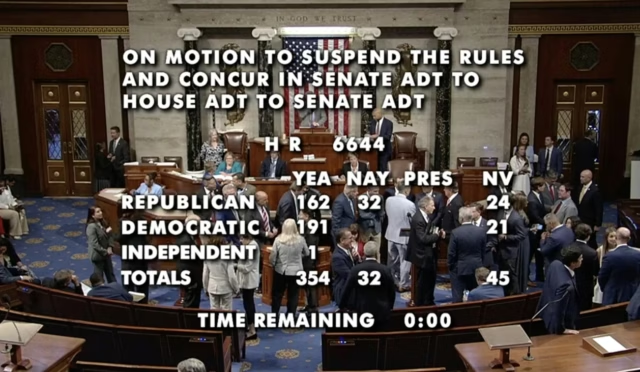 After months of wrangling, the housing bill passed the Senate and House (above) by huge margins with bipartisan support.CSPAN
What’s in the 21st Century Road to Housing Act
The final version of the 381-page bill includes 45 provisions with major implications for housing. Many of the measures are aimed at boosting housing production to address a massive national shortfall.
Realtor.com economists estimate that the country has a shortage of more than 4 million homes, as a consequence of more than a decade of building fewer homes than were needed to meet demand.
“Among other things, the legislation aims to incentivize homebuilding by establishing policy guidelines and best practices, streamlining environmental review, and improving existing programs, including tying community development block grants to housing outcomes,” says Realtor.com Chief Economist Danielle Hale. “This last provision enables the federal government to put its finger on the scales of policymaking at the state and local level, where many of the policy and regulatory hurdles to homebuilding exist.”
The legislation also makes changes to make it easier to build and finance both manufactured and modular homes, which could bring down construction costs if used more widely.
Key provisions of the bill include the following:
-
Restricting corporate buyers: Blocks Wall Street firms and large institutional investors from mass-purchasing single-family homes, backing the ban with steep financial penalties.
-
Zoning reform: Creates a $200 million grant program to reward cities that eliminate restrictive zoning, while penalizing slow-growth communities by cutting their Community Development Block Grant funding by 10%.
-
Cutting regulatory red tape: Accelerates construction timelines by waiving lengthy NEPA environmental reviews for low-impact HUD projects and streamlining repetitive property inspections.
-
Expanding mortgage access: Launches a HUD pilot program to expand access to small-dollar mortgages below $100,000 and increases the amount of private bank capital that can be invested in local affordable housing.
-
Modernizing factory-built housing: Updates FHA lending standards and draw schedules to give manufactured and modular housing financing parity with traditional, site-built homes.
-
Disaster recovery fixes: Permanently authorizes the Community Development Block Grant-Disaster Recovery framework for faster postdisaster rebuilding and protects low-income rural tenants from losing rental assistance when a property’s underlying mortgage matures.
Realtor.com